
Biological Info: Spanish Mackerel
About Us | Biological Info | Management Info | Habitat Info | Legal & Socio – Economic Issues | Resources & Publications | Fisheries FAQ
Family Scombridae (Mackerels & Tunas)
|
Scientific Name:
|
Scomberomorus maculatus |
|
Common Names:
|
Spanish |
|
Range & Habitat:
|
Spanish mackerel are distributed Gulfwide in coastal nearshore waters and saline estuaries and bays. |
|
Identification & Biology:
|
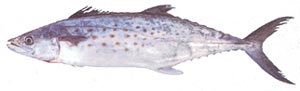
The body is elongated and strongly flattened from side-to-side. They are green above with silver sides, heavily marked with oval yellow or golden-olive spots. This species closely resembles the cero in color, however the spots on the cero are arranged in a row and the cero has 1 or 2 longitudinal stripes that are the same color as the spots. Both species have a pronounced black spot on the front of the dorsal fin.
Spanish mackerel are schooling predators that relentlessly attack schools of smaller fish, especially anchovies. Often, diving gulls will attack the terrified prey fish forced to the surface by the mackerel and other fish that join them, such as spotted seatrout, jacks, ladyfish, and bluefish. Feeding Spanish mackerel will gracefully leap clear of the water. Spanish mackerel grow fast, to 12-15 inches in length their first year, and few fish live beyond 3-5 years. They spawn during the warm months of the year. |
|
Size:
|
Spanish mackerel will grow to 27 inches long and 12 pounds, although the average is less than one-third of that. Smaller fish are more common inshore. |
|
Food Value:
|
Good, but it does have a high-oil flesh, which makes it more suitable for broiling than frying. |