Research banner image
Student Research

Student Research

Artificial Reef Research Assistantship Program (ARRAP)

Applications from faculty are closed.

The program provides graduate assistantship stipends of $25,000 annually, for up to three years, to Master of Science/Arts students enrolled full-time at Louisiana colleges and universities who are involved in research relevant to the Louisiana Artificial Reef Program (LARP). Students receiving assistantships also are required to intern with LARP at least 100 hours each year with a mentor assigned by the program. Louisiana Sea Grant administers the assistantships with funding provided by LDWF.

About ARRAP | Application Info | Funded Projects | Contact
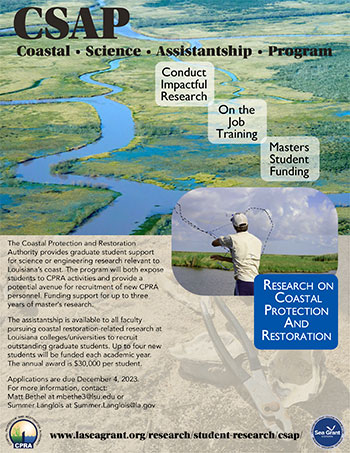


Image: CSAP flyer, FY 2024Coastal Science Assistantship Program (CSAP)

Applications for 2026 assistantships are now closed.

The Louisiana Coastal Protection and Restoration Authority (CPRA) continues its support of a graduate assistantship opportunity called the Coastal Science Assistantship Program (CSAP). This program provides graduate assistant stipends for up to three years to Master of Science students both enrolled full-time at Louisiana colleges/universities and involved in research relevant to Louisiana coastal protection and restoration efforts.

Background | Application | Selected Proposals | Student BiosContact


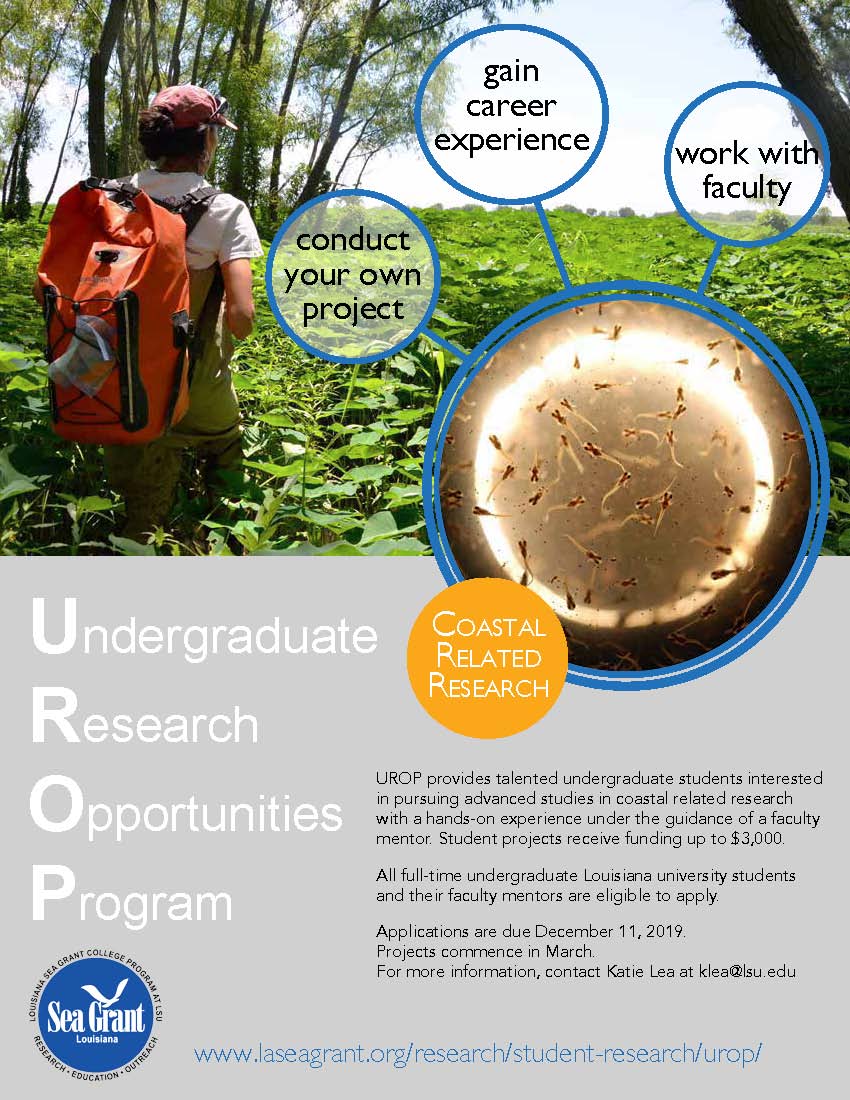
Image: UROP flyer FY2025

Undergraduate Research Opportunities Program (UROP)

Application deadline for 2025 funding was December 12, 2024 at 11:59pm CST.

The goal of the Undergraduate Research Opportunities Program (UROP) is to increase the number of undergraduates pursuing coastal science careers by encouraging and supporting specific undergraduate research activities. Students propose, carry out and report results of a research project related to an existing project funded by Sea Grant.

About UROP | FAQs Funded Projects | Application | Contact


Dr. Jack and Annagreta Hojhdal Van Lopik Superior Graduate Student Research Scholarship Program

Applications for the scholarship are closed.

Dr. Jack Van Lopik, the first and longest serving Director of the Louisiana Sea Grant College Program at LSU, and his wife Annagreta Hojhdal Van Lopik, established the Dr. Jack and Annagreta Hojhdal Van Lopik Superior Graduate Student Scholarship (Van Lopik Scholarship) to assist graduate students pursuing advanced degrees in disciplines related to the mission and focus areas of the Louisiana Sea Grant College Program, as detailed in the Strategic Plan of the organization. The intent is to support the Sea Grant mission of furthering the wise and sustainable use of ocean and coastal resources by increasing the number of researchers and the body of knowledge in related fields including but not limited to biology, ecology, geology, fisheries, environmental science, coastal resiliency and design, natural resources economics, environmental education and disaster preparedness, extension and resiliency.

About | Applications | Current Recipients | Past Recipients


Graduate Interjurisdictional Research Award Fellowship (GIRAF)

Offered in Partnership by Louisiana Space Grant (LaSPACE) & Louisiana Sea Grant (LSG)

Applications for the fellowship are closed.

The joint Louisiana Space Grant and Sea Grant Graduate Interjurisdictional Research Award Fellowship (GIRAF) Program invites interdisciplinary proposals from across the state. The fellowship requires the use of data from vast archives and remote-sensing capabilities available through the National Aeronautics and Space Agency (NASA) and the National Oceanic and Atmospheric Administration (NOAA) to address a high-priority research need within Louisiana’s nearshore environs, coastal areas, wetlands, watersheds, and/or human activities in these areas (e.g. aquaculture). Successful proposals must adeptly utilize relevant measurement instruments and/or remote-sensing data sources from NASA, NOAA, and/or other sources that can include, but are not limited to, radiometers, spectroradiometers, satellite sensors, LIDAR, aerial imagery, and other data collected from airplanes, unmanned aerial vehicles, and/or unpiloted submersibles in the execution of the proposed work. —  more about GIRAF